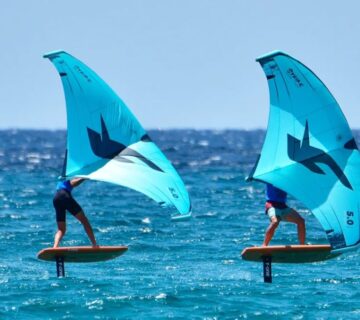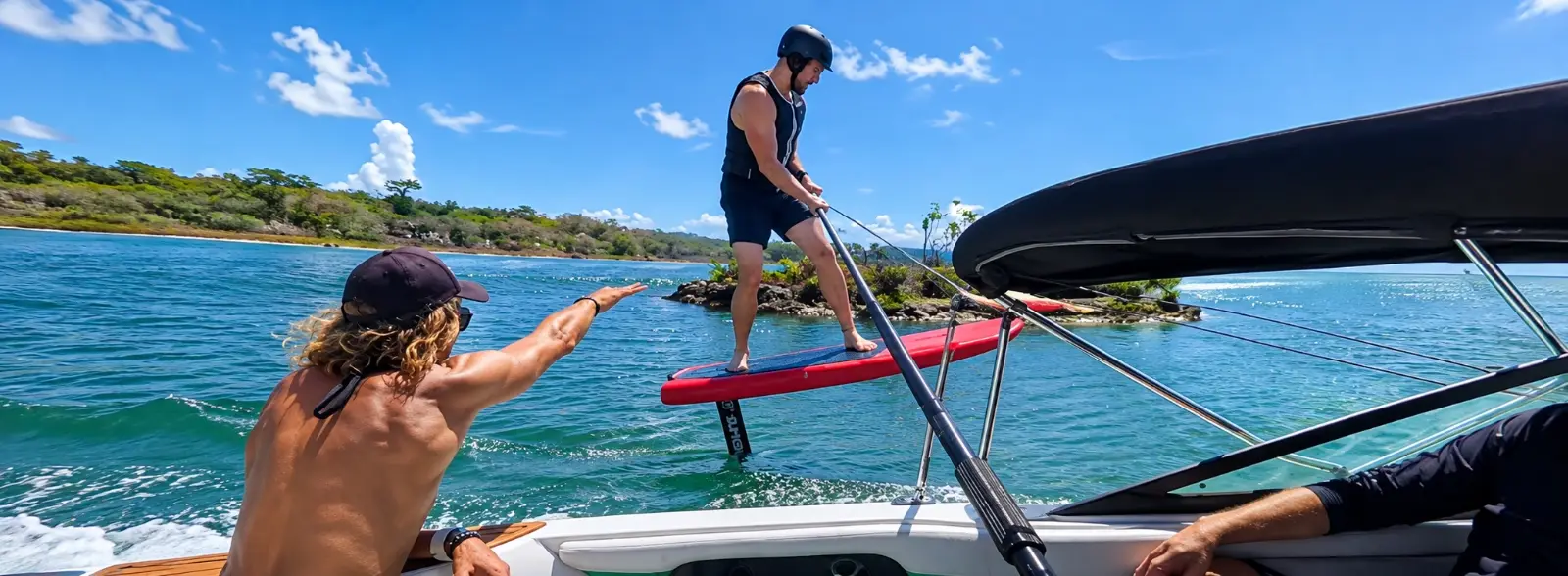
There are three common ways to learn to hydrofoil: behind a boat, with a wing, or with a kite. The fastest route for most people is to learn the foil itself first, without also managing a wing or kite, and towing behind a boat is the most direct way to do that. Once the board feels natural in flight, adding a wing or kite becomes much easier.
The hard part of foiling is not the power source. It is balance, body position and controlling how high the board flies.
What makes foiling hard
A hydrofoil lifts the board out of the water on a mast and wing. Lean too far forward and the board drops; too far back and it rises and breaches. Small shifts in weight change everything. Learning that feel takes time on the water, and it is harder when you are also steering a wing or flying a kite.
Route 1: Behind a boat
The boat gives you a steady, controlled speed, so all your attention goes to the foil. You learn how the board responds to speed, weight and stance, then work toward your first stable flights.
This is how our Foil Clinic with Boat works. It runs on a private lake at the Mayan Water Complex with our own boat, in small groups, and does not need wind. A typical session goes from a land briefing, to getting comfortable with the board at speed, to finding lift and refining control.
Good for: complete beginners to foiling, wing foilers who want more stable flight, kiters preparing for kite foiling.
Route 2: With a wing
Wing foiling combines a handheld wing with a foil board. Beginners usually start on a large, stable board without much foil time, learn to handle the wing, then progress onto the foil. It is a natural route if your main goal is wing foiling.
The challenge is doing two new things at once: managing the wing and balancing on the foil. That is why some riders do a boat session first. See wing foil lessons and Kiteboarding vs Wing Foiling.
Good for: people who want to wing foil, riders coming from windsurfing or SUP.
Route 3: With a kite
Kite foiling is for riders who already kiteboard well. At PDCK, kite foil lessons require you to ride upwind and do transitions comfortably, because the kite has to be second nature before you add the foil. Lessons use a progressive setup with different mast lengths. See hydrofoil kite lessons.
Good for: confident kiteboarders who want light-wind riding and a new challenge.
Which order makes sense?
- New to everything: a boat session to learn the foil, then wing or kite lessons.
- Already wing foiling but struggling to stay up: boat time focused on balance and takeoffs.
- Kiteboarder: consolidate upwind riding and transitions, then kite foil lessons; a boat session first can shorten the adjustment.
Practical tips
- Expect falls. Low speed and short masts make early falls gentler.
- Wear a helmet and a vest. Both are provided in our lessons.
- Short, focused sessions beat long tired ones when you are learning balance.
Want to try foiling? See the Foil Clinic with Boat or send us your experience level.